
🎟️ Tickets: €17.5 online (adults) | Free under 18 | Free 1st Sunday of every month
⏰ Hours: 9:30 AM – 6:00 PM (Closed Mondays) | Thursdays until 9:45 PM
📍 Address: Esplanade Valéry Giscard d’Estaing, 75007 Paris
🚇 Metro: RER C “Musée d’Orsay” | Metro 12 “Solférino”
⏳ How long: 2–3 hours (highlights) | 3–4 hours (thorough visit)
🎨 Famous for: World’s largest Impressionist collection — Monet, Van Gogh, Renoir, Degas, Cézanne
Book Skip-the-Line Tickets — from €17.5 →
Check Guided Tour Availability →
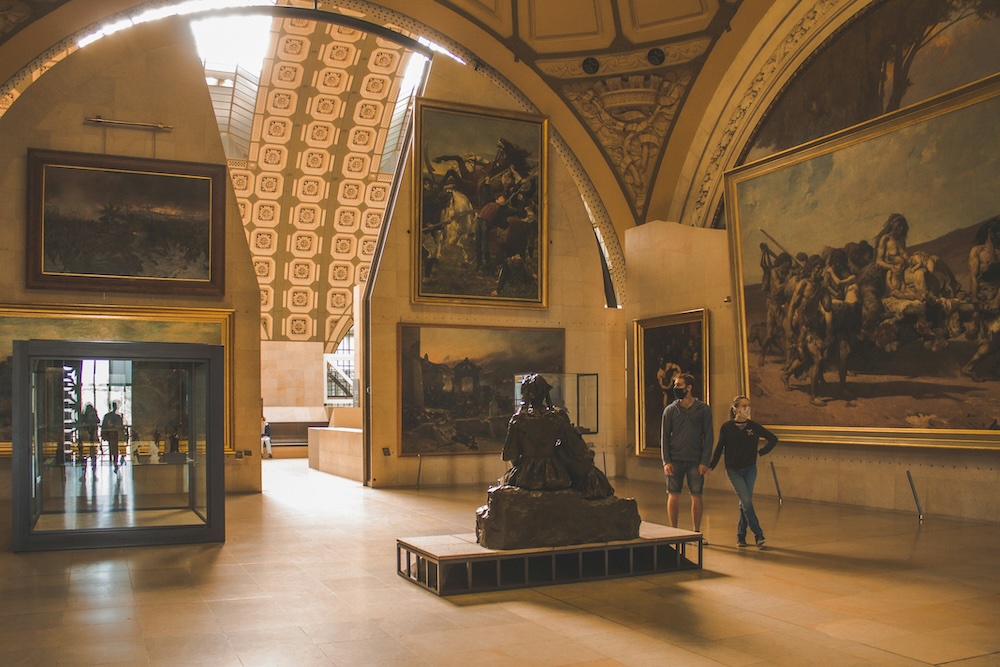
The Musée d’Orsay is Paris’s most beloved art museum after the Louvre — and for many visitors, it’s actually the better experience. Housed inside a stunning former railway station on the Left Bank of the Seine, the Orsay Museum holds the world’s largest collection of Impressionist and Post-Impressionist art, with masterpieces by Monet, Van Gogh, Renoir, Degas, and Cézanne spread across five floors.
If you’re planning a visit in 2026, there are a few things you need to know: Musée d’Orsay tickets should be booked online in advance (the on-site ticket queue can stretch past 45 minutes in peak season), major renovation work is underway on the entrance areas through 2028 (but the museum stays fully open), and this is a special year — the museum’s 40th anniversary and the centenary of Claude Monet’s death. This guide covers everything: current ticket prices, opening hours, the must-see works, and how to make the most of your visit.
Musée d’Orsay Tickets & Prices (2026)
Musée d’Orsay tickets cost €16 per adult when booked online. The on-site ticket price is €14, but you’ll wait in a separate (longer) queue to purchase them, then wait again to enter. Online tickets give you access to the priority entrance at Entrance A, which is significantly faster.
|
Ticket Type |
Price |
Where to Buy |
|---|---|---|
|
Adult (online, timed entry) |
From €16 |
Tiqets / Official site musee-orsay.fr |
|
Adult (on-site, at the counter) |
€14 |
Museum ticket desk (longer wait) |
|
“Enfant & Cie” (EU resident adult with child under 18) |
€13 |
Official site only |
|
Under 18 |
Free (ID required) |
No ticket needed |
|
EU residents 18–25 |
Free (ID required) |
No ticket needed |
|
Thursday evening (entry after 6 PM) |
€12 |
Online or on-site |
|
1st Sunday of the month |
Free for all |
Free reservation required online |
|
Audio guide (on-site rental) |
€6 |
Museum desk — 300+ works, 10 languages |
🇫🇷 LES FRENCHIES TIP: The €2 difference between online and on-site tickets is misleading. Online tickets aren’t just about saving €2 — they give you access to the priority entrance lane, which can save you 30–60 minutes during busy periods. Always book online.
Your best options for Musée d’Orsay tickets:
🇫🇷 LES FRENCHIES TIP: If you’re visiting the Louvre too, consider a Paris Museum Pass (2 days €62, 4 days €82). It covers both museums plus 50+ others and includes skip-the-line access. It pays for itself in 4–5 visits if you plan on visit many monuments. If that’s not your case, then it’s not worth it.
Musée d’Orsay Opening Hours (2026)
|
Day |
Hours |
Last Entry |
|---|---|---|
|
Tuesday |
9:30 AM – 6:00 PM |
5:00 PM |
|
Wednesday |
9:30 AM – 6:00 PM |
5:00 PM |
|
Thursday |
9:30 AM – 9:45 PM |
9:00 PM |
|
Friday |
9:30 AM – 6:00 PM |
5:00 PM |
|
Saturday |
9:30 AM – 6:00 PM |
5:00 PM |
|
Sunday |
9:30 AM – 6:00 PM |
5:00 PM |
|
Monday |
CLOSED |
– |
Also closed: May 1 and December 25.
Free admission days: The first Sunday of every month is free for everyone, but you must reserve a free timed-entry slot online in advance. These slots fill up fast — book at least 2 weeks ahead.
🇫🇷 LES FRENCHIES TIP: Thursday evening is our favorite time to visit. After 6 PM the crowds thin out dramatically, the ticket price drops to €12, and the light through the station’s massive clock face at sunset is unforgettable. If your schedule allows it, Thursday evening is the move.

⚠️ 2026 Renovation: What Visitors Need to Know
Starting March 10, 2026, the Musée d’Orsay is undergoing major renovation work on its entrance forecourt and canopy structures. The project runs through summer 2028.
The museum stays fully open throughout the renovation. All collections, temporary exhibitions, and programming remain accessible. The only change is that entrance access points may be temporarily modified depending on construction progress. This means your walk to the entrance might look different than what you see in photos or older blog posts, but once inside, the experience is the same.
The renovation is improving visitor accessibility, energy efficiency, and restoring heritage elements of the 1900-era building. Check the museum’s website on the day of your visit for the latest entrance information.
What to See at the Musée d’Orsay: 10 Must-See Masterpieces
The Orsay Museum holds over 4,000 works spread across five floors. You can’t see everything in one visit — and you shouldn’t try. Here are the 10 works we always recommend to first-time visitors, organized by floor so you can plan an efficient route.
Ground Floor (Rez-de-chaussée)
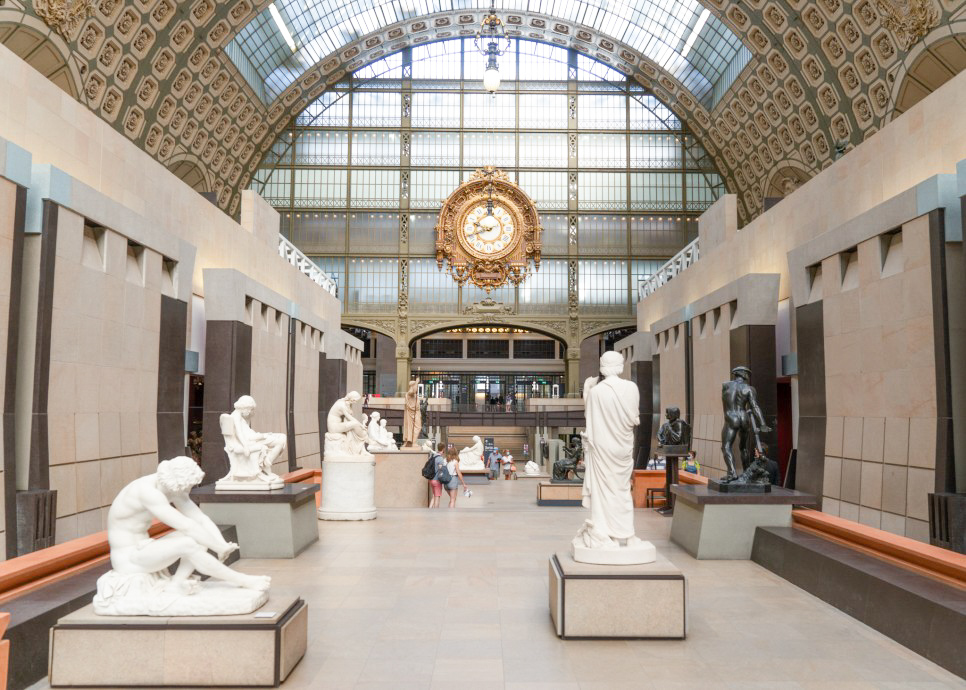
1. Édouard Manet — “Olympia” (1863) The painting that scandalized Paris. Manet’s bold, unapologetic nude was considered shocking not because of the nudity itself (nudes were common in academic painting) but because Olympia stares directly at the viewer with the confident gaze of a real woman, not an idealized goddess. It essentially launched modern art.
2. Gustave Courbet — “The Painter’s Studio” (1855) A massive canvas (nearly 6 meters wide) that Courbet described as a “real allegory.” It shows the artist at work surrounded by figures representing different aspects of society. It’s a manifesto of Realism and one of the most ambitious paintings of the 19th century.
3. Jean-François Millet — “The Gleaners” (1857) Three peasant women bending to collect leftover grain after a harvest. What looks like a simple rural scene was actually a radical political statement — it put the poorest workers at the center of a monumental canvas, a format previously reserved for nobility and mythology.
Upper Level (Niveau supérieur) — The Impressionist Galleries
This is what most visitors come for. The entire upper level is dedicated to the Impressionists and Post-Impressionists.
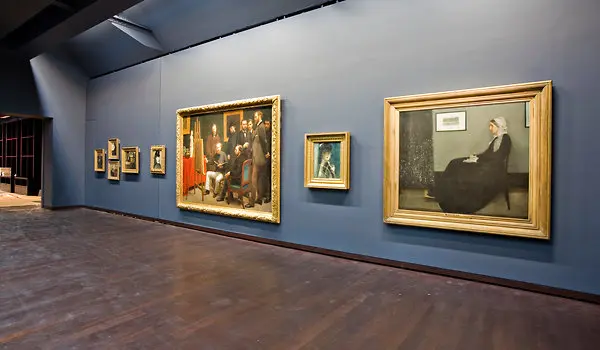
4. Claude Monet — “Woman with a Parasol” (1886) Two versions of this painting hang near each other — Suzanne Hoschedé captured from opposite angles on a windy day. The brushwork is so loose it almost dissolves into pure light and movement. Standing in front of these in person is nothing like seeing them in a book.
5. Pierre-Auguste Renoir — “Bal du moulin de la Galette” (1876) A sun-dappled scene of Parisians dancing at a Montmartre open-air dance hall. The dappled light filtering through the trees is Impressionism at its most joyful. One of the most celebrated paintings in the world, and it’s right here.
6. Vincent van Gogh — “Starry Night Over the Rhône” (1888) Not to be confused with “The Starry Night” (which is at MoMA in New York). This painting captures the night sky reflected in the Rhône river at Arles. The blues and golds are even more striking in person than in reproduction.
7. Vincent van Gogh — “Self-Portrait” (September 1889) Van Gogh painted over 30 self-portraits. This one, created at the asylum in Saint-Rémy-de-Provence, is dominated by swirling blue-green patterns. His gaze is intense but fragile. It’s one of the most recognized paintings in the museum.
8. Edgar Degas — “Blue Dancers” (c. 1890) Degas was obsessed with ballet dancers, and this painting captures them in an intimate backstage moment — adjusting their costumes, stretching, preparing. The vibrant blue pastels are unmistakable. The Orsay holds the world’s finest collection of Degas’s ballet works.
9. Claude Monet — “Rouen Cathedral” series (1892–1894) Monet painted the same cathedral facade over 30 times at different times of day and in different light conditions. Several hang together at the Orsay, and seeing them side by side is the single best way to understand what Impressionism was actually about — capturing how light transforms what we see.
Middle Level (Niveau médian)
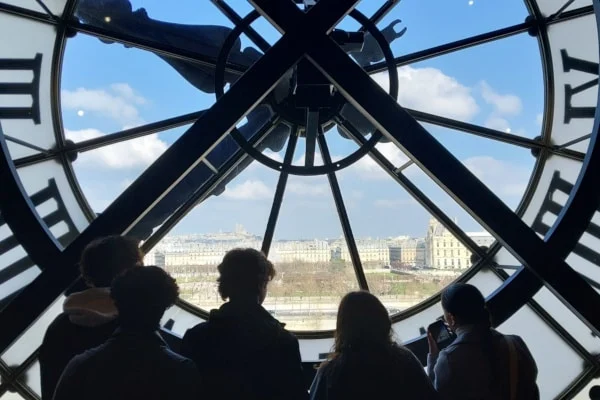
10. The Giant Clock Not a painting, but the most photographed spot in the museum. The enormous station clock on the upper level offers a stunning view through its translucent face toward the Sacré-Cœur and the Paris rooftops. It’s a reminder that you’re standing inside a 1900-era train station — and it makes for an incredible photo.
🇫🇷 LES FRENCHIES TIP: Start your visit on the upper level (take the escalator immediately after entering). The Impressionist galleries get the most crowded by late morning. If you arrive at opening and head straight up, you’ll have Monet, Van Gogh, and Renoir practically to yourself for 20–30 minutes.
2026 Exhibitions at the Musée d’Orsay
This is a particularly exciting year to visit. The Musée d’Orsay turns 40 in 2026, and 2026 also marks the centenary of Claude Monet’s death. The museum has programmed a major lineup:
|
Exhibition |
Last Entry |
Tickets |
|---|---|---|
|
Renoir Drawings |
March 17 – July 5, 2026 |
Included in Entrance ticket |
|
Renoir and Love: A Joyful Modernity (1865–1885) |
March 17 – July 19, 2026 |
Included in Entrance ticket |
|
Youssef Nabil: To Dream Again (contemporary art) |
May 19 – September 13, 2026 |
– |
|
Auguste Bartholdi: Liberty Enlightening the World |
September 15, 2026 – January 31, 2027 |
– |
|
Mary Cassatt: The Choice of Independence |
October 6, 2026 – January 31, 2027 |
– |
|
Jenny Holzer: J’ai vu |
October 20, 2026 – February 21, 2027 |
– |
The Renoir exhibition in spring and the Mary Cassatt show in fall are the headliners. If you’re visiting between March and July, book a timed slot for Renoir in advance — the museum expects high demand and recommends reserving a specific window to guarantee access.
How to Get to the Musée d’Orsay
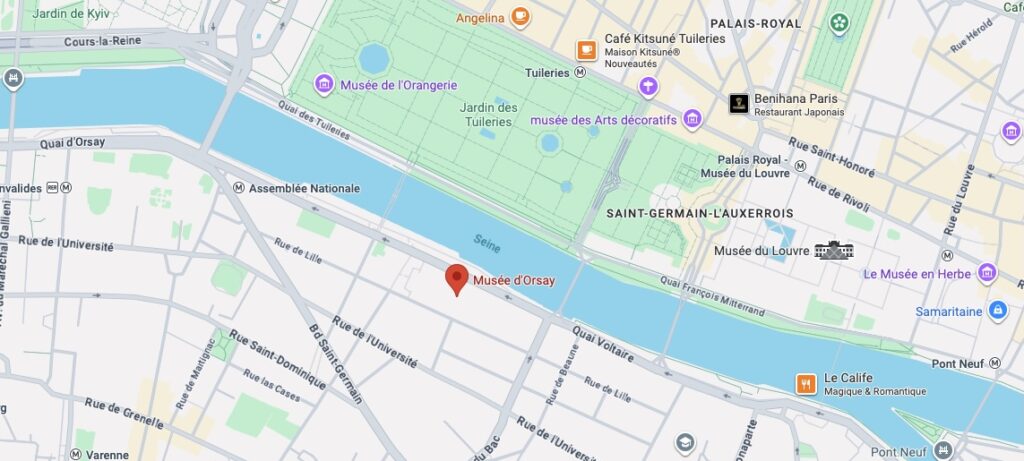
The museum sits on the Left Bank of the Seine, directly across the river from the Tuileries Garden and about a 15-minute walk from the Louvre.
By Metro/RER (fastest): The most convenient option is the RER C to the station literally called “Musée d’Orsay” — it drops you at the museum’s doorstep. Alternatively, Metro Line 12 to “Solférino” is a 5-minute walk. If you’re coming from further afield, Metro Line 8 or 13 to “Invalides” works too (10-minute walk).
On foot from nearby attractions: From the Louvre: 15 minutes along the Seine (cross at Pont Royal) — a beautiful walk. From Saint-Germain-des-Prés: 10 minutes north through Rue de l’Université. From the Eiffel Tower: 20–25 minutes along the river.
By Batobus (hop-on hop-off boat): The Batobus has a stop right in front of the museum. If you have a Batobus pass, it’s a scenic way to arrive. See the full guide →
Tips for Visiting the Musée d’Orsay
Best time to visit: Wednesday and Friday mornings are the quietest weekdays. Thursday evenings after 6 PM offer a magical experience with fewer crowds and sunset light through the clock face. Avoid Tuesdays — the Louvre is closed on Tuesdays, so Louvre crowds spill over to the Orsay.
How long to spend: Plan 2–3 hours for the highlights (Impressionist galleries + ground floor masterpieces). Art lovers who want to explore Post-Impressionism, Art Nouveau furniture, and photography should budget 3–4 hours. Include a break at Café Campana on the upper level — it’s designed by the Campana Brothers and has beautiful views.
Guided tour or self-guided? If you’re not deeply familiar with Impressionism, a guided tour is worth it. A good guide doesn’t just point at paintings — they explain why Monet’s brushstrokes were revolutionary, what made the art establishment so furious, and the personal stories behind the artists. The 2-hour semi-private tours from Viator and GetYourGuide are consistently well-reviewed.
Photography: Allowed for personal use throughout the permanent collection (no flash, no tripods). Temporary exhibitions may have restrictions posted at the entrance.
Cloakroom: Free cloakroom service available. You can leave bags up to 56 × 45 × 25 cm. No re-entry once you exit.
Combine with nearby attractions: The Orsay is perfectly positioned for a Left Bank day. After your visit, walk 10 minutes to the Musée de l’Orangerie (Monet’s Water Lilies) or cross the river to the Tuileries and Louvre. See all Paris Attractions →
Musée d’Orsay vs. the Louvre: Which Should You Visit?
This is one of the most common questions we get in our community. The honest answer: visit both if you have time. But if you can only choose one:
|
Last Entry |
Tickets |
|
|---|---|---|
|
Best for |
Impressionism, Post-Impressionism (1848–1914) |
Ancient art through 18th century, Renaissance |
|
Size |
Manageable — 2–3 hours |
Massive — minimum half day |
|
Crowds |
Busy but navigable |
Can be overwhelming |
|
Star works |
Monet, Van Gogh, Renoir, Degas |
Mona Lisa, Venus de Milo, Winged Victory |
|
The building |
Gorgeous train station — part of the experience |
Enormous palace — can feel impersonal |
|
Our take |
More intimate and emotionally engaging |
More historically comprehensive |
Many visitors tell us the Orsay was their favorite museum in Paris — even more than the Louvre. The building itself is stunning, the collection is focused enough to feel satisfying in a single visit, and Impressionist art tends to resonate emotionally even with people who don’t consider themselves “art people.”
Book Your Musée d’Orsay Visit
❓ Frequently Asked Questions
How much are Musée d’Orsay tickets in 2026?
Standard adult tickets cost €16 when booked online (€14 at the on-site counter). Thursday evening entry after 6 PM costs €12. Children under 18 and EU residents aged 18–25 enter free. The first Sunday of every month is free for everyone with a reserved time slot.
What are the Musée d’Orsay opening hours?
The museum is open Tuesday through Sunday from 9:30 AM to 6:00 PM, with last admission at 5:00 PM. On Thursdays, it stays open late until 9:45 PM (last admission 9:00 PM). The museum is closed every Monday, on May 1, and on December 25.
How long should I spend at the Musée d’Orsay?
Most visitors spend 2 to 3 hours seeing the highlights, which include the Impressionist galleries on the upper level and the major works on the ground floor. Art enthusiasts who want to explore the full collection including Post-Impressionism, sculpture, Art Nouveau, and photography should plan 3 to 4 hours.
What is the best time to visit the Musée d’Orsay?
Wednesday and Friday mornings tend to be the quietest. Thursday evenings after 6 PM are excellent — fewer crowds, lower ticket price, and beautiful sunset light through the giant clock. Avoid Tuesdays, when the Louvre is closed and its visitors come to the Orsay instead.
Is the Musée d’Orsay open during the 2026 renovation?
Yes. The museum remains fully open throughout the renovation (March 2026 through summer 2028). All collections and exhibitions are accessible. Only the entrance areas and forecourt are affected — check the museum’s website for the most current access information before your visit.
Is a guided tour of the Musée d’Orsay worth it?
For first-time visitors, a guided tour significantly enhances the experience. The Orsay’s collection spans a revolutionary period in art history, and a knowledgeable guide explains why these paintings were so radical and the personal stories behind each artist. A 2-hour guided tour covers the essential masterpieces and costs from €70 per person including skip-the-line entry.
Is the Musée d’Orsay covered by the Paris Museum Pass?
Yes. The Paris Museum Pass provides skip-the-line access to the Musée d’Orsay plus 50+ other museums and monuments in Paris. You still need to reserve a free timed-entry slot. The pass costs €62 for 2 days, €82 for 4 days, or €110 for 6 days.
What is the most famous painting at the Musée d’Orsay?
The museum’s most iconic works include Van Gogh’s “Starry Night Over the Rhône” (1888), Renoir’s “Bal du moulin de la Galette” (1876), and Monet’s “Woman with a Parasol” (1886). The Impressionist and Post-Impressionist galleries on the upper level contain the highest concentration of famous works.